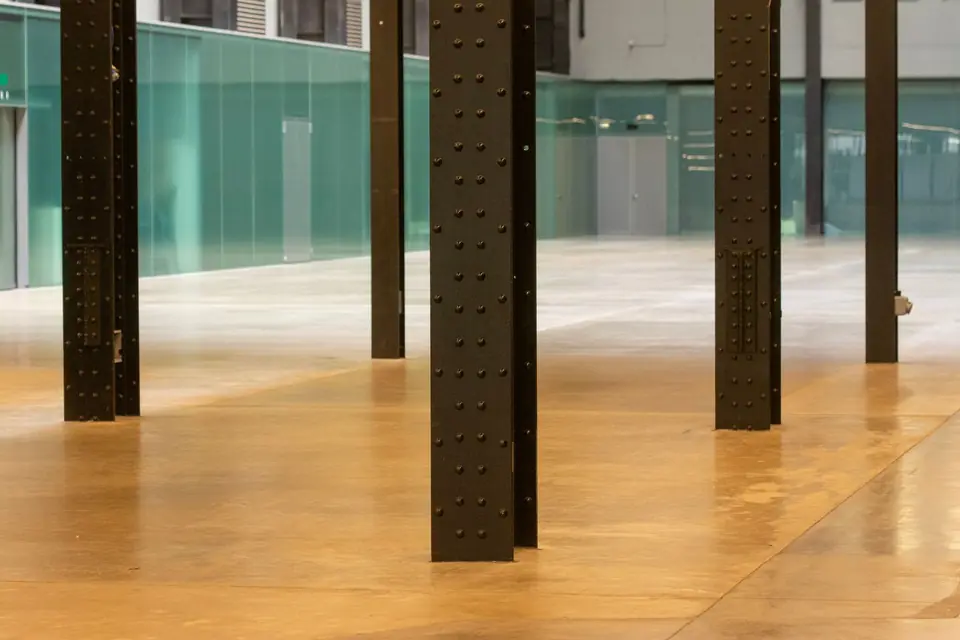
CSI 03 35 43 · Polished concrete finishing
Industrial diamond-polished concrete
The slab becomes the floor. Mechanical grinding, lithium or sodium silicate densifier and resin-bond polishing produce a dense, bright surface with no coating to peel — the lowest lifecycle cost in dry warehousing.
- Installed (large)$1.50–$6+/sf
- Under 5,000 sf$3–$12/sf
- Return to serviceimmediate–24 h
- Life10–20+ yrs
Aggregate exposure classes
How deep the first metal-bond grind cuts determines what you see. The class must be specified before the slab is poured if a uniform look matters, because exposure depends on how flat the slab is and how close to the surface the aggregate sits.
| Class | Look | Cut depth | Notes |
|---|---|---|---|
| A — Cream | Paste surface, little or no aggregate | ~1/16 in. | Lowest grind cost; shows trowel marks and color variation |
| B — Salt & pepper | Fine aggregate exposed | ~1/8 in. | The common warehouse choice; hides wear |
| C — Medium aggregate | Coarse aggregate exposed, terrazzo-like | ~1/4 in. | Most grinding passes; flatness (FF/FL) critical |
Grit progression
- 30–100 metal bond — removes laitance, opens the surface to the specified class, flattens high spots.
- Densifier — lithium or sodium silicate reacts with calcium hydroxide to harden the paste and reduce dusting.
- 200–400 resin — honed matte finish (Level 1–2). Basic warehouse spec.
- 800 resin — medium gloss, noticeable reflectivity gain (Level 3). Standard distribution center spec.
- 1500–3000 resin + burnish — high gloss (Level 4). Showrooms, prestige distribution; can be slick when wet or dusty.
- Guard / stain protector — sacrificial penetrating or topical guard for oil and food spill resistance.
Installed cost by finish and scale
| Finish | Grit | Large warehouse $/sf | Under 5,000 sf $/sf | Life |
|---|---|---|---|---|
| Basic warehouse, Class A/B | 400 | $1.50–$2.75 | $3.00–$5.00 | 10–20+ yrs |
| Standard warehouse, Class B/C | 800 | $2.50–$4.00 | $4.50–$7.00 | 15–20+ yrs |
| High-gloss industrial, Class C | 1500–3000 + guard | $3.50–$6.00+ | $6.00–$12.00 | 15–20+ yrs |
Polishing rates already reflect warehouse scale, so no further scale discount is applied in the estimator. Joint filling and spall repair are priced separately. How these ranges are built.
Reflectivity: the energy argument
An 800-grit floor reflects substantially more light than a raw or dusty troweled slab, which brightens picking aisles under the same fixtures and reduces the need for supplemental task lighting at rack faces. In high-bay distribution, that is often the deciding factor between polished concrete and a coated floor.
What polished concrete cannot do
| Exposure | Result | Choose instead |
|---|---|---|
| Acids (food, battery, chemical) | Etches paste and exposes aggregate | Urethane cement or novolac epoxy |
| Standing oil, hydraulic fluid | Penetrates and stains despite guard | Coated floor in maintenance bays |
| USDA/FSIS seamless sanitation | Joints and pores not cleanable to standard | Urethane cement with integral cove |
| ESD program | Uncontrolled resistance | ESD epoxy |
Polished concrete is breathable, so slab moisture does not delaminate it — but the joints still move. Fill control joints with semi-rigid polyurea after the slab has shrunk; see joint repair.
Get the slab walked before the budget is locked
Send square footage, facility type, slab condition and your shutdown window. A Bodenmuller estimator reviews the scope, plans ASTM F2170 testing where it is needed and returns a formal proposal.